

WooCommerce is one of the most flexible e-commerce platforms available. Its low barrier to entry and vast ecosystem of off-the-shelf add-ons allow stores to launch quickly, but as order volumes grow and business logic becomes more complex, many merchants realize they need custom WooCommerce plugins to scale efficiently.
While standard extensions work well for simple stores, high-volume operations eventually hit what engineers call “The Plugin Ceiling.”
Symptoms of reaching this ceiling include:
- Slow checkout times and lagging admin dashboards.
- Database bloat caused by hundreds of unused metadata fields.
- Plugin updates breaking critical site functionality.
- Off-the-shelf tools forcing you to compromise your actual business workflows.
When off-the-shelf add-ons stop scaling, stacking more generic third-party tools only compounds the problem. The real solution is transitioning from bloated code to custom WooCommerce plugins built specifically around your store’s exact operational requirements.
Why Standard Plugins Fail High-Volume Stores
Off-the-shelf plugins are designed for the average user, meaning they must cater to hundreds of edge cases you will never need. To achieve maximum compatibility across different WordPress setups, plugin developers make architectural compromises that hurt performance at scale.
1. Database Bloat and Unindexed Metadata
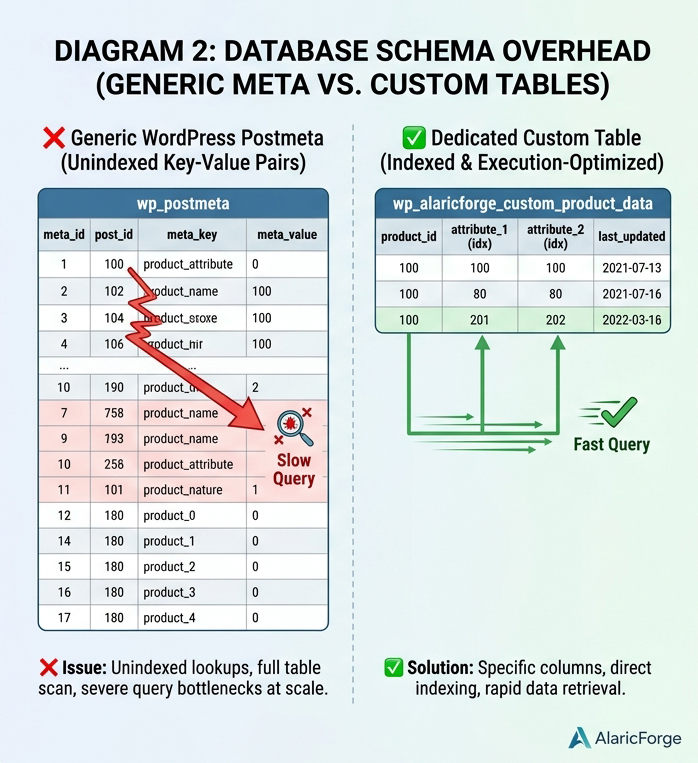
By default, WordPress stores post meta in the wp_postmeta table as key-value pairs. Standard plugins frequently store complex configuration settings, custom order fields, and session logs inside this single unindexed table or inside wp_options as autoloaded data.
When your store reaches tens of thousands of orders:
- Database queries slow down exponentially.
- Unused options autoload on every single page request.
- Simple reporting queries begin timing out during peak traffic.
2. The Hook and Filter Overhead
Every plugin added to WordPress hooks into core execution cycles. When you have 30 or 40 active plugins, every single HTTP request—whether a user loading a product page or an automated API sync—triggers hundreds of unnecessary function checks.
Standard Stack (Bloated Execution Path): [ HTTP Request ] ➔ [ 40+ Active Plugins ] ➔ [ 100s of Unused Hooks ] ➔ [ Heavy wp_postmeta Queries ] ➔ [ High TTFB Response (2.4s) ]
Custom Architecture (Optimized Execution Path): [ HTTP Request ] ➔ [ WooCommerce Core ] ➔ [ Tailored Custom Logic ] ➔ [ Indexed Custom DB Table ] ➔ [ Fast Response (0.3s) ]
This structural overhead slows down time-to-first-byte (TTFB) and increases server memory consumption, requiring expensive hosting upgrades that only mask the underlying issue.
3. Brittle Dependencies and Security Risks
Relying on dozens of separate plugin vendors means your store’s stability depends on third-party update schedules. A security patch in one plugin can conflict with another, causing unexpected downtime or broken checkout funnels during critical sales windows.
The Alternative: Tailored Custom Operational Logic
Transitioning to custom development doesn’t mean reinventing WooCommerce. It means replacing heavy, generalized plugins with lightweight, purpose-built code designed specifically for your store’s architecture.
Feature | Off-the-Shelf Plugins | Custom Operational Logic |
Code Footprint | Bloated with features you don’t use | Lightweight and execution-focused |
Database Design | Generic wp_postmeta / wp_options | Indexed custom database tables |
Maintenance | Frequent vendor update conflicts | Clean, documented codebase |
Performance Impact | High memory and query overhead | Optimized for rapid execution |
Business Fit | Forces you to adapt to the software | Software adapts to your exact workflow |
How to Build Scalable WooCommerce Extensions
When engineering custom solutions for high-volume WooCommerce environments, professional software teams rely on three core architectural principles:
1. Dedicated Custom Database Tables
Instead of stuffing specialized data into the core wp_postmeta table, custom logic uses dedicated, indexed database tables. This structure allows queries to run in milliseconds without cluttering WordPress core tables, ensuring fast report generation and instant API responses.
2. Decoupled Processing & External APIs
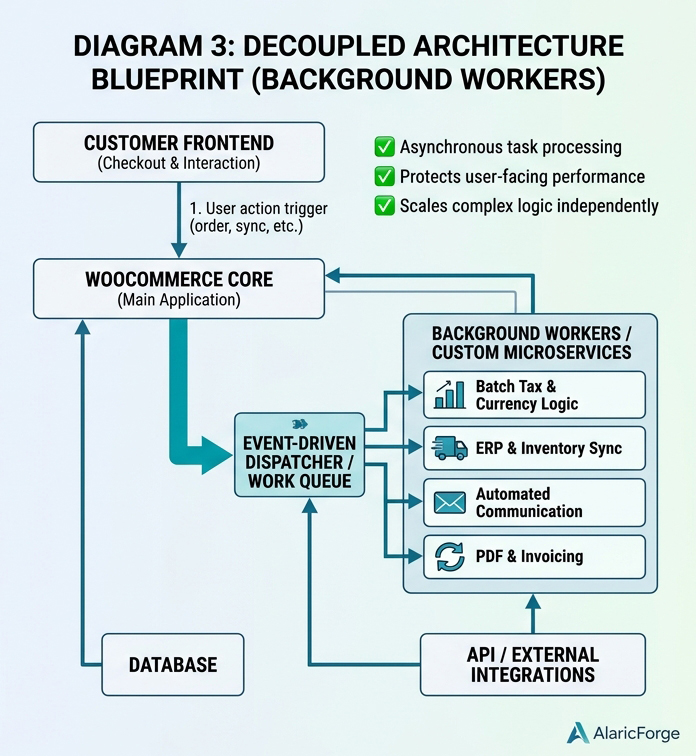
For resource-intensive tasks—such as batch tax calculations, complex multi-currency synchronization, or automated inventory syncs with external ERPs—heavy calculations should be offloaded to custom microservices or background workers. This keeps the frontend checkout lightning-fast for buyers.
3. Strict Code Standards & Isolated Business Rules
Custom code shouldn’t be scattered across standard theme functions files. Clean architecture uses modular, object-oriented plugin design that isolates core business logic, making future upgrades simple and preventing site-wide failures.
Is It Time to Switch to Custom WooCommerce Plugins?
If your business is experiencing any of the following signs, you have outgrown standard plugin stacks:
- Checkout Friction: Your checkout takes more than 2 seconds to load or process payment.
- Workaround Fatigue: Staff members spend hours manually moving data between plugins, spreadsheets, or third-party tools.
- Feature Bloat: You use only 5% of a heavy plugin’s capabilities, but it slows down your entire site.
- Operational Risk: Updates regularly break custom rules or cause site errors.
Partner with AlaricForge for Custom WooCommerce Engineering
At AlaricForge, we design and build bespoke software solutions, tailored WooCommerce extensions, and reliable operational backends built around real business workflows.
We help scaling businesses replace fragile plugin chains with fast, predictable, and fully custom operational logic.
Ready to optimize your WooCommerce architecture? Schedule a technical consultation with the AlaricForge engineering team to review your store’s codebase, identify bottlenecks, and build software tailored to your growth.
More information about AlaricForge Custom Software Solutions, you can find below:
If you liked this article, you might also like Custom Software vs. Off-the-Shelf: How to Choose the Right Solution for Your Business.